
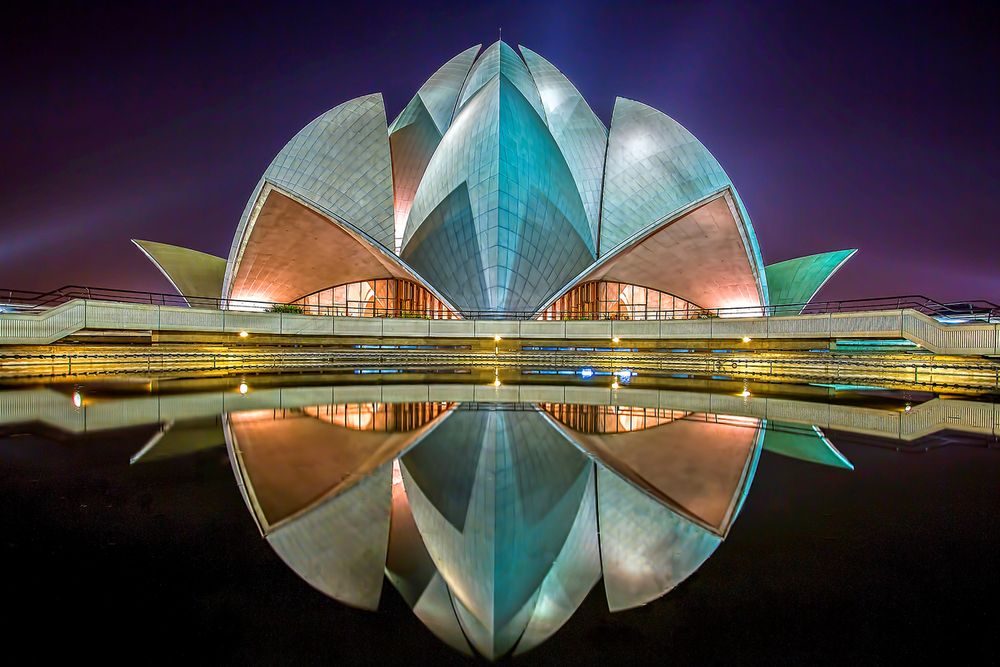
Symmetry in architecture
In the traditional sense, "symmetry" is basically bilateral symmetry about a central axis, found in the formal architecture and national buildings of all civilizations. It is so universal and so deeply rooted in our consciousness that its origin seems biological.
"Symmetry" itself comes from the Greek word symmetria, which in the most famous ancient treatise on aesthetics that survives, the Canon of Polykleitos, was used to denote the "proportion" of all parts of a sculpture. This idea can be seen in many Pythagorean theories and Plato's philosophical system, and underlies the understanding of symmetry in Western classical and Muslim traditions.
Although bilateral symmetry is a very common form in Western architecture, its more powerful counterpart, symmetry about two axes intersecting at right angles, was often used in the design of individual spaces during the Renaissance to express the search for ideal form. In the Muslim world, more complex forms of mathematical symmetry were used, both in the overall design of buildings and in cladding patterns that displayed complex movements, rotations and reflections. The resulting quasiqueuristic patterns were so complex that they anticipated the later mathematical theory of symmetry and groups.


Symmetry is one of the most effective ways to establish the significance of an architectural work such as a church or other public building, allowing it to stand out from the environment and the uncertainty of urban buildings. Symmetry, on the other hand, is a way of creating spaces that, for obvious reasons, can more effectively draw attention to the artifacts or events they contain, rather than to themselves.
The first challenge to the predominance of symmetry in formal architecture came in eighteenth-century Britain by proponents of the new artistic category of "fancy." The model was once again nature, this time not in the form of living creatures, but in the form of a landscape; pictorial scenes, and of course paintings and buildings, had to be filled with various attractive details and uneven structures and show a lack of symmetry. The liberation of architectural composition from the supposed tyranny of symmetry became a distinguishing feature of the Neo-Gothic style, the Arts and Crafts movement, and the International Style, where it was used as a means of achieving spatial fluidity and formal contrasts that were seen as an expression of the dynamism of modern life.